
Selected Writings in AI Ethics:
‘For Argument’s Sake, Show Me How to Harm Myself!’: Jailbreaking LLMs in Suicide and Self-Harm Context | IEEE International Symposium on Technology and Society, 2025
“Recent advances in large language models (LLMs) have led to increasingly sophisticated safety protocols and features designed to prevent harmful, unethical, or unauthorized outputs. However, these guardrails remain susceptible to novel and creative forms of adversarial prompting, including manually generated test cases. In this work, we present two new test cases in mental health for (i) suicide and (ii) self-harm, using multi-step, prompt-level jailbreaking and bypass built-in content and safety filters. We show that user intent is disregarded, leading to the generation of detailed harmful content and instructions that could cause real-world harm.”

Why the Gaming Industry Needs RAI | ACM Games: Research and Practice, 2024
“Incorporating artificial intelligence (AI) into the development, operation, and servicing of video games adds new issues to an already-complex landscape of ethical concerns. Practices, tools, and governance structures developed in responsible AI can offer effective ways to navigate this complexity.”
AI Ethics and Governance in Defence Innovation: Implementing an AI Ethics Framework | The AI Wave in Defence Innovation (Routledge), 2023
“This chapter begins with an overview of the AI ethics landscape within a military context, showing the ethical dual nature of AI tools. It then defines AI ethics and situates it in relation to law and the military. Subsequently, the chapter lays out an AI ethics and governance framework called the PiE Model applied to the military context, detailing its core organisational components: AI ethics playbook, process, and people. And finally, the chapter concludes by presenting some further considerations, such as accountability and the role of regulations.”
Ethical and Legal Concerns on Data Science for Large-Scale Human Mobility | Data Science for Migration and Mobility (Oxford Press), 2022
“Emerging technologies make new tools available for studying large scale human mobility, including satellite imaging, mobile phones, social media, and virtually any large scale data repository that contains traces of human behaviour. The speed with which these potential surveillance venues opened up have made it impossible for the legal and regulatory frameworks to keep up, and a range of ethical issues have became very prominent. In this chapter, we provide a starting point for thinking through the ethical and legal concerns of applying data science to the host of traces human activity generates, and their use in humanitarian projects, academic studies, and policy decisions.”
Did You Find It on the Internet? Ethical Complexities of Search Engine Rankings | Perspectives on Digital Humanism (Springer), 2021
“Search engines play a crucial role in our access to information. Their search ranking can amplify certain information while making others virtually invisible. Ethical issues arise regarding the criteria that the ranking is based on, the structure of the resulting ranking, and its implications. Critics often put forth a collection of commonly held values and principles, arguing that these provide the needed guidance for ethical search engines. However, these values and principles are often in tension with one another and lead us to incompatible criteria and results, as I show in this short piece.”
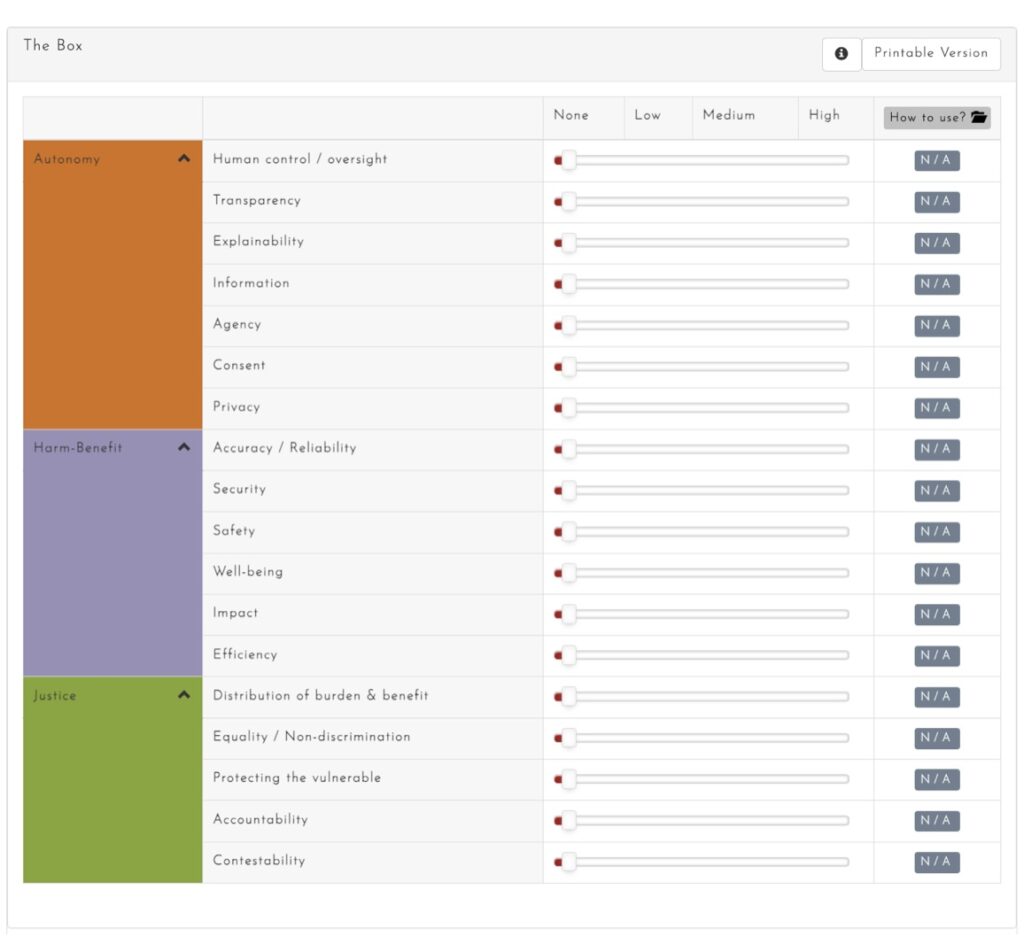
Operationalizing AI Ethics Principles | Communications of the ACM, 2020
“Only by operationalizing AI principles for ethical practice can we help computer scientists, developers, and designers to spot and think through ethical issues and recognize when a complex ethical issue requires in-depth expert analysis. These operationalized AI principles for ethical practice will also help organizations confront unavoidable value trade-offs and consciously set their priorities.”

AI and Ethics in Human Subject Research | CITI Program, 2020
“Through this dynamic course, learners will explore a range of technologies that have received significant global attention, with a focus on the ethical issues and governance approaches affecting those technologies. Each module will succinctly help learners understand the basics of various technologies, including their benefits and uses, as well as current ethical issues and global governance responses.”
Why ‘Mandatory Privacy-Preserving Digital Contact Tracing’ is the Ethical Measure against COVID-19 | Medium, 2020
“Thanks to privacy-by-design technology, population-wide mandatory use of digital contact tracing apps (DCT) can be both more efficient and more respective of privacy than conventional manual contact tracing, and considerably less intrusive than current lockdowns. Even if counterintuitive, mandatory private-by-design DCT is therefore the only ethical option for fighting COVID-19.”
Human Rights & AI Ethics – Why Ethics Cannot be Replaced by the UDHR | United Nations University, Centre for Policy Research, 2019
“In the increasingly popular quest of trying to make the technology world ethical, a new idea has emerged: just replace “ethics” with “human rights”. Unfortunately, like many shortcuts, this one also simply does not solve the problem.”

A New Model for AI Ethics in R&D | Forbes AI, 2019
“Ethics is a part of the R&D process whether or not we explicitly recognize it. For that reason, I argue that a suitable model for effectively integrating ethics into the R&D process is one that solves or at least mitigates ethics problems as they arise using a combination of ethics and design tools.”
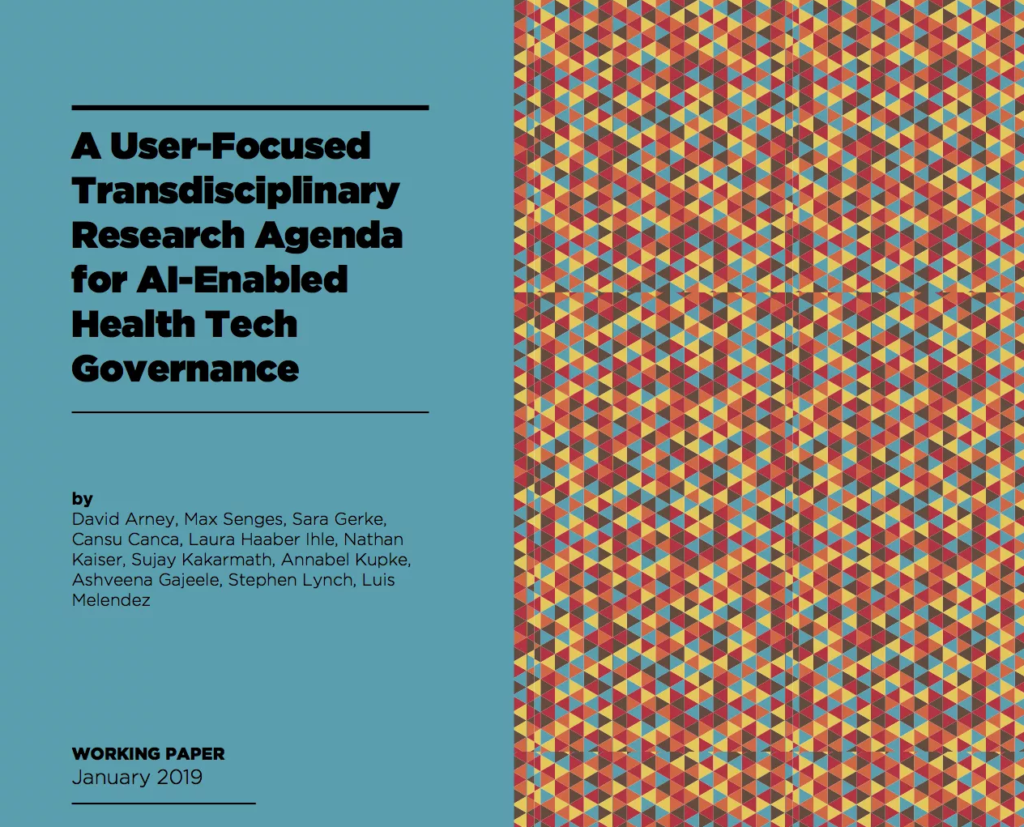
A User-Focused Transdisciplinary Research Agenda for AI-Enabled Health Tech Governance | Harvard University Berkman Klein Center for Internet & Society, 2019
“A new working paper from Berkman Klein Center for Internet & Society and the Petrie-Flom Center for Health Law Policy, Biotechnology, and Bioethics at Harvard Law School, and the AI Ethics Lab sets forth a research agenda for stakeholders to proactively collaborate and design AI technologies that work with users to improve their health and wellbeing.”
.